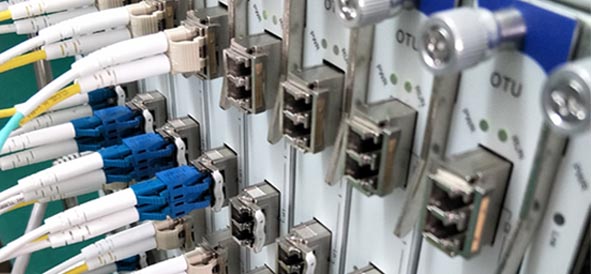
Wavelength division multiplexing (WDM) sends several independent channels down one fiber pair, each on its own colour of light. It is the standard answer to the most expensive sentence in networking — "we are out of fiber" — because it multiplies the plant you have instead of rebuilding it. GRT is a manufacturer of WDM equipment, supplying CWDM and DWDM multiplexers and complete large-data transmission solutions built around them.
CWDM versus DWDM in one paragraph each
CWDM (coarse WDM) spaces channels widely, which permits uncooled lasers and lower-cost optics. It suits metro and campus distances and moderate channel counts, and it is usually the economical first step off a single dark pair. DWDM (dense WDM) packs channels tightly with temperature-controlled lasers, reaching far higher channel counts and long-haul distances — the carrier discipline. The choice is therefore not better-or-worse but count-and-distance: how many channels, over how many kilometres, at what per-channel rate. Our blog guide works the comparison in full.
Two system facts are worth fixing before any design conversation. First, WDM is transparent: each wavelength is an independent channel that can carry Ethernet, storage or legacy protocols side by side. Second, the multiplexers themselves are passive at the fiber level — the channels are combined and separated optically — so the powered equipment in a WDM design is the channel optics at each end, not the mux on the shelf.
How many channels can I add to one fiber pair?
It depends on the discipline and channel plan — CWDM counts in the handful-to-18 range, DWDM far beyond. Give us your target channel count and distance and we will spec the system.
Do I need special transceivers?
Yes. Each channel needs an optic tuned to its wavelength. GRT supplies the channel optics with the system so mux and lasers are specified together.