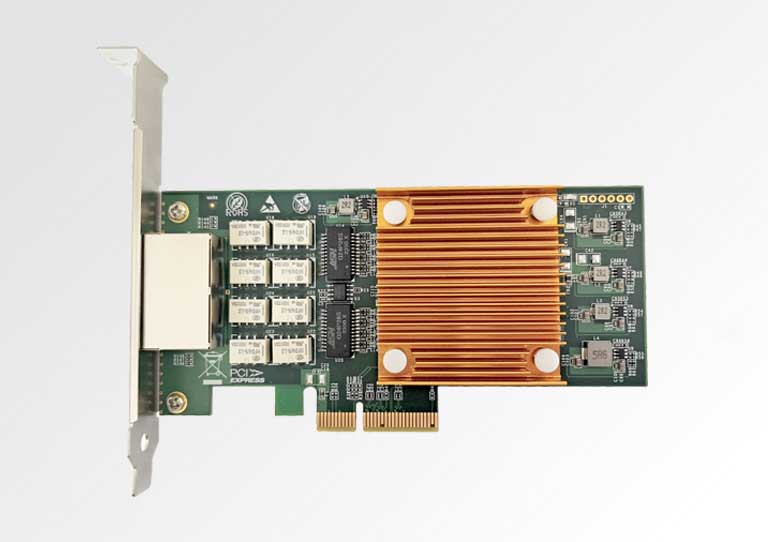
The FF-902TBP-V3.0 is a single-path, dual-port gigabit bypass server adapter built on the G350AM2, an Ethernet controller developed by GRT. It brings the bypass discipline of high-end inline appliances down to gigabit copper links — and it does so on a purely domestic design, for deployments where the controller itself must be autonomously controlled. The card connects over PCI-Express x4 and presents two gigabit RJ45 ports.
Bypass behaviour is the point of the product. Three working modes — Normal, Bypass and Disconnect — are software-programmable, letting the host appliance define link policy for every operating state. An on-board watchdog timer controller supervises the system with a programmable timeout from 100 ms to 3,276.8 s. If the host hangs, the watchdog expires and the card switches the link automatically. If the host loses power entirely, the card still performs the bypass switch, so a dead appliance never becomes a dead network segment.
Virtualisation and host interface
The adapter supports flexible I/O virtualisation with up to 16 virtual channels, enough to share one bypass pair across a handful of virtual security functions. Its high-performance host interface follows PCI Express 2.1, and the card can emulate standard NIC behaviour when the appliance software expects an ordinary adapter. In other words, it drops into existing gigabit inline designs — firewalls, gateways, traffic shapers and auditing boxes — without demanding a platform redesign.
| Model | FF-902TBP-V3.0 |
|---|---|
| Controller | GRT G350AM2 Ethernet controller, self-developed |
| Ports | Dual gigabit RJ45 (copper) ports, single bypass path |
| Host interface | PCI-Express x4 (PCI Express 2.1) |
| Working modes | Normal / Bypass / Disconnect, software programmable |
| Watchdog | On-board WDT controller, programmable timeout 100 ms – 3,276.8 s |
| Power-off behaviour | Automatic bypass switching on power loss |
| Virtualisation | Flexible I/O virtualisation, up to 16 virtual channels |
| Design | Purely domestic design, autonomously controlled; can emulate a standard NIC |
Where gigabit bypass still earns its place
Not every inline link is 100G. Branch gateways, industrial control segments, campus uplinks and legacy enforcement points still run on gigabit copper — and they are exactly the links that cannot afford an appliance-shaped hole when hardware fails. The FF-902TBP gives those segments carrier-style link protection on a domestic controller, at a gigabit price point.
Detailed numeric specifications for this model (power, dimensions) are confirmed per project; the functional specification above is the documented one. Contact our team with your appliance platform and link requirements for a quotation and, if needed, a loaner evaluation unit.
Does the link survive a total power failure of the appliance?
Yes. The card switches to bypass automatically on power loss, keeping the network path connected while the appliance is down.
How is this different from the 100G bypass card?
Rate and medium: this model protects gigabit copper (RJ45) links on a domestic G350AM2 controller; the F1102EBPLR protects 100G optical links on an Intel E810-CAM2. Both share the same Normal / Bypass / Disconnect model and watchdog concept.
Can it act as a normal NIC?
Yes, the card can emulate standard NIC function, which eases integration with appliance software that expects a conventional adapter.
Integration checklist
Integrating a bypass card is mostly a cabling and policy exercise. Wire the protected link through the card’s port pair, confirm the appliance sees both directions in Normal mode, then rehearse the three failure drills before production: stop the appliance software (watchdog expiry should switch the link), reboot the host (the link should ride through in bypass), and remove power entirely (the link must persist). Record the failover time the network team measures in each drill; that number, agreed in the lab, is what operations will expect at 3 a.m. Only after all three drills pass does the appliance own the link.